January
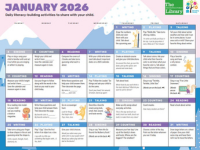
You have been your child’s teacher from the day he or she was born. You know more about your child than anyone else, and you are in the best position to help your child get ready to read. Whether your child is four days old or four years old, it is not too early or too late to help them develop pre-reading skills.
- Draw the numbers 2026 and color them with your child. Talk about the upcoming year.
- Play “Riddle Me.” Take turns offering riddles. I’m white and fluffy and in the sky. I can be gray when it rains. What am I? Yes! Clouds!
- Tell your child about winter weather and how cold it can be in some places. Is your area cold or mild? Share your favorite thing about winter.
- Play or sing a song your child is familiar with and act it out while you are singing or while it is playing.
- Weigh your child and write it here: ______ Save the calendar and measure again in June.
- Compare the covers of 2 books and take turns guessing what each is about.
- With your child write down (and talk about) important dates on a 2026 calendar.
- Create an obstacle course and give your child directions. Go around the chair, go over the book, pick up the spoon, turn around and come back.
- Talk about colors. Ask your child what their favorite color is and share what your favorite color is. Talk about things that are those colors.
- Play a favorite song and have a silly dance contest.
- Measure your child’s height and write it here: _______ Save the calendar and measure again in June.
- Use your finger to follow along with the words in the book as you read to your child today.
- Write these questions and help your child answer them. Then decorate the page. My name is ______. I am ______ years old.
- Play “Follow the Leader.” Do things and ask your child to do the same. Touch your head, Turn around, Sit down, Stand up again!
- Talk about food. Which food do you think is the most delicious? What do you want to eat for dinner?
- Sing or say “Twinkle, Twinkle, Little Star.” Twinkle, twinkle, little star / How I wonder what you are / Up above the world so high / Like a diamond in the sky / Twinkle, twinkle, little star / How I wonder what you are
- Sing or say “Five Little Snowmen.” Five little snowmen standing in a row, (Hold up five fingers) / Each had a hat and a big red bow (Put hands on head and then neck) / Out came the sun and stayed all day, (Circle arms overhead) / And one little snowman melted away. (Slump down) / Repeat with 4, 3, 2, 1, until no snowmen are left.
- Be a reading role model. Let your child see you reading a book or magazine.
- Write these questions and help your child answer them. Then decorate the page. My favorite color is _____. My favorite animal is ______.
- Go on a scavenger hunt. Look for things that begin with T. Toys, trees, toes.
- Describe a favorite snack using look, smell, feel, sound, and taste words.
- Make up silly songs about everyday activities. This is the way we brush our teeth, brush our teeth, brush our teeth, to make them very clean!
- Count snacks. How many crackers are there?
- Read a book about winter.
- Take turns using your finger to draw shapes in the air and guessing what the shape is. Circle, square, triangle, heart, diamond, etc.
- Play “I Spy.” Give the first letter of an object as a clue. I spy with my little eye something that begins with…D. Yes, dish!
- Give your child choices. Would you rather wear your white shirt or your purple shirt? Would you rather play with the ball or the blocks?
- Sing or say “Here We Go Round the Mulberry Bush.” Sing the Chorus: / Here we go round the mulberry bush, / the mulberry bush, the mulberry bush; / Here we go round the mulberry bush, / On a cold and frosty morning. / Action verses: Pick an action and sing “This is the way we [action]…” while doing the motion. / Example actions: wash our hands, brush our teeth, button our coats, put on boots, tie our scarves, shovel snow.
- Measure your feet day! Line up all the family’s shoes and boots. Whose are the biggest? The smallest?
- Choose a letter of the day. Point out the letter wherever you see it today.
- Draw large letter on a sheet of paper. Give your child some clay and have them roll it out to trace the letters.
February
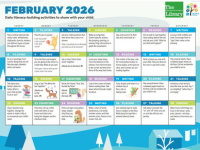
How we read to children is as important as how often we read to them. No matter what your child’s age, reading together with your child or shared reading is the single most important activity that you can do to help your child get ready to read. Engage your child in back and forth conversations about the books you read. Children learn more words when they have the opportunity to respond to questions. If English is not your first language, speak to your child in the language you know best. This allows you to explain things to your child more fluently.
- Place writing materials like sticky notes, whiteboards, clipboards, stencils, markers, and different types of paper throughout the house.
- Play the yes-no game! Is the sky purple? Is the cat pink? Is the door closed?
- Ask your child questions that have more than a yes or no answer. What is something fun we did today and what can we do tomorrow?
- Make up songs that involve specific actions, like jumping, spinning, or waving. Sing instructions to guide the movements.
- Clap and count to 10, then clap and count back to 1.
- Pick a book to read together. Stop reading before the end and ask your child, “What do you think will happen?”
- Let your child scribble and draw. Encourage them to “sign” their name on the drawing.
- Go on a scavenger hunt. Look for things that are red like stop signs, blankets, shirts, and socks.
- Sit on the floor and imagine you are going to the moon in a rocket ship. What do you see? There goes a house, there go the clouds, there’s the moon!
- Say or sing “Zoom Zoom Zoom” together. Zoom Zoom Zoom, / We’re going to the moon (point to the sky) / Zoom Zoom Zoom, / We’re leaving very soon, If you want to take a trip, Climb aboard my rocket ship, / Zoom Zoom Zoom, / We’re going to the moon, (point to the sky) / Zoom Zoom Zoom, / We’re leaving very soon. / 10, 9, 8, 7, 6, 5, 4, 3, 2, 1 Lift off! (children can jump up or lift baby up)
- Count your steps today. From the bedroom to the kitchen. From the front door to the corner and then from there all the way back home.
- Pick a letter of the day. Look for it everywhere today: on license plates, at the grocery store, and in books you are reading together.
- Write a thank-you note with your child. They can draw on the note or sign their name.
- Play musical hearts. Place numbered paper hearts on the floor. Call out numbers for your child to run to.
- Talk about your family’s plans for today. What is your child excited to do or see?
- Sing or say “The More We Get Together.” The more we get together / Together, together / The more we get together / The happier we’ll be / ‘Cause your friends are my friends / And my friends are your friends / The more we get together / The happier we’ll be
- Recite the rhyme, “One, Two, Buckle My Shoe.” One, two; buckle my shoe / Three, four; shut the door. / Five, six; pick up sticks. / Seven, eight; don’t be late. / Nine, ten; do it over again!
- Look at the covers of books before reading them. Talk about what the books might be about.
- Trace shapes and letters in a shallow tray of flour, salt, or baking soda.
- Play musical hearts. Place numbered paper hearts on the floor. Call out numbers for your child to run.
- Introduce a new word to describe how you feel. Say “I am delighted” rather than I am happy.
- Sing a favorite song together. Change the words to make it silly or to incorporate your child’s name.
- Play store. Set up a little store with items in your house and take turns being the shopper and the checkout clerk.
- Point out signs everywhere today. Explain what they say and how they help.
- Make a chart of family preferences. List family member names and their favorite colors, flavors of ice cream, fruit, etc.
- Use masking tape to make lines or shapes on the floor. Walk along the tape like a pretend balance beam.
- Talk about concepts like “on” and “off” when you put on and take off hats and jackets.
- Make music with things you have in the house – pots, pans, spoons – and sing and dance to the music you make.
March
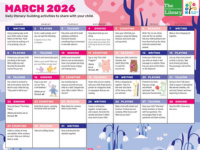
Playing to learn new words. Play is one of the best ways for children to learn language and literacy skills. Play helps children feel a sense of accomplishment and self-confidence. This motivates them to try new experiences and not to give up when something seems difficult. Also, it’s fun!
- Using masking tape, write your child’s name in large letters on the floor. Trace each letter by walking on it or by pushing a toy car.
- Go for a walk outside, see if you can spot the following: A Squirrel; A Car; A Tree; An Airplane
- Play show-and-tell to build speaking confidence. Everyone chooses something they’re interested in and talks about it.
- Sing about what you are doing. This is the way we eat our food, eat our food, eat our food. This is the way we put on our shoes, etc.
- Have your child help you prepare a recipe by helping measure and count cups and spoonfuls.
- Write “Yes” on one sticky note and “No” on another. Ask your child questions and have them hold up the sticky note that matches their answer.
- Make a short shopping list together.
- Pretend you and your child are diving in the ocean. What might you see? Describe the beautiful marine life you see.
- Point to and name body parts. Where is your mouth? Where are your ears? Where are your toes?
- Gather some household items to use as instruments. Have a fun parade marching around the house singing and making music.
- Say or sing “Five Little Froggies.” Five little froggies sat on a shore. (Crouch like a frog) / One went for a swim, then there were four. (Pretend to leap and swim off) / Four little froggies (Crouch like a frog) / Looked out to sea. (Put your hand at brow and look out to sea) / One went swimming, and then there were three. (Pretend to leap and swim off) / Three little froggies said, “What can we do?” / One jumped in the water, then there were two. (Pretend to leap and swim off) / Two little froggies sat in the sun. (Crouch like a frog) / One swam off, and then there was one. (Pretend to leap and swim off) / One little Froggie said “This is no fun!” / He dived in the water, and then there were none!
- Show your child a selection of books. Ask which they'd like to read first, second, etc.
- Invite your child to help you write an email or text message to a relative. Show how you pick out the letters on the keyboard.
- Line up chairs and pretend to drive a city bus. Take turns driving and being the passenger. Call out the stops!
- Use a block to pretend to talk on the phone. Hand the block to your child and say, “They want to talk to you.”
- Sing or say and act out “Here is the Beehive.” Here is the beehive. (Make a fist) / Where are the bees? / Hiding inside where nobody sees. / Watch them come creeping out of the hive, / One, two, three, four, five (Release one finger at a time from the fist/hive) / BUZZ-ZZZ (Wiggle fingers)
- Use masking tape to measure yourself and your child on the wall. Compare the sizes. Who is taller? Who is shorter.
- Share what you are reading with your child. Read aloud a portion of a magazine, book, or newspaper that you are reading.
- Write a shopping list together. Take it to the store and check off the items as they are selected.
- Pretend to be birds. Flap your wings and whistle and tweet. Talk about your favorite birds.
- Spring is here! Talk about what to expect in Springtime like warmer weather, rain and mud, flowers and trees beginning to blossom.
- Sing and dance “The Hokey Pokey.” You put your right foot in / You take your right foot out. / You put your right foot in / And you shake it all about. / You do the hokey pokey / And you turn yourself around. / That’s what it’s all about. / Repeat with “left foot,” “ right hand,” “left hand,” and “whole self”!
- Build block towers, counting the blocks while you build.
- Make labels for common items in your home.
- Create a writing box together. Include paper and crayons. Decorate the outside and leave it within easy reach of your child.
- Make a tent with sheets and furniture. Pretend you are camping. What do you see? What do you hear?
- Have your child “interview” family members or friends with fun questions. This encourages them to ask questions and listen actively.
- Sing the ABCs. Slow once, fast once.
- Collect a variety of rocks and pebbles. Write numbers on each. Help your child put them in order.
- Take turns telling stories.
- Draw and decorate the alphabet together.
April
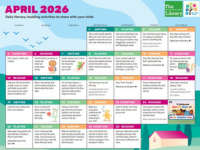
Talking is one of the best ways for children to learn new words. Speak to your child often during the day and try to use many different words to express your ideas. Children love to imitate, and they will try to imitate your speech. Chances to chat include while you are getting dressed in the morning, eating breakfast, riding in the car, walking from the car to a store, playing together, doing chores, taking a bath, going to bed, and while saying goodnight. Ask lots of open-ended questions, those that require more than a yes or no answer.
- Take a walk outside together. When you return home, work together to draw the story of your walk. What did you see?
- Take turns pretending to be a variety of animals. Bark and wag your tail like a dog. Wriggle like a snake. Be a bird flapping its wings.
- Say a favorite nursery rhyme, but change an important word to something silly. Hickory Dickory Dock, the mouse ran up the tree…
- Has it been raining a lot? Sing “Rain, Rain, Go Away.” Rain, Rain / Go Away; / Come again / Another day; / Little [child’s name] / Wants to play
- Find 1 spoon, 2 socks, and 3 books.
- Visit the library (in person or online) and check out books about spring.
- Create a piece of art. Look at the sky and draw clouds. Be sure to sign your name!
- Play Follow the Leader. One person (the leader) performs actions the others must follow. Take turns being the leader.
- Go on a nature walk and look for items that start with different letters of the alphabet. For example, “F is for flower, T is for tree.”
- Sing “Row, Row, Row Your Boat” during bath time. Row, row, row your boat / Gently down the stream / Merrily merrily, merrily, merrily / Life is but a dream
- Cut a piece of toast in half. Say “Now we have two pieces the same size.”
- Help your child stack blocks as high as you can. Count each block as you add it. How many can you stack before it tumbles over?
- Make a dot painting with cotton swabs and paint to help develop fine motor skills.
- Cut out large shapes – a square, a triangle, a circle – and place them on the floor. Take turns telling which shapes to step on.
- Talk about your day and their day. I’m making breakfast. You’re playing with blocks. We’re getting ready to go out.
- Sing “I Hear Thunder” to the tune of “Frère Jacques.” I hear thunder, I hear thunder. (Pounds hands gently on floor or lap) / Listen, don’t you? Listen, don’t you? (Cup hand to ear) / Pitter, patter raindrops; Pitter, patter raindrops; (Wiggle fingers in falling motion in front of face) / I’m wet through (Shake body) / So are you!
- Draw a chalk grid with numbers and have the child jump to the numbers you call out.
- Teach letter sounds by playing “I Spy.” I spy with my little eye something that begins with S. Yes! A spoon!
- Label the room. Sticky-note three to five objects.
- Go on a circle hunt! Make a list of all the circle-shaped items you find today.
- Choose a word of the day. Write the word down together. Use the word several times during the course of the day.
- Make up a song about something that is familiar or interesting to your child.
- Count in nature. How many birds, rocks, flowers, trees do you see?
- Place pieces of paper with big letters written on them around the room. Help your child find them. Where’s the letter A? On the chair!
- Celebrate Día del Niño at Be My Neighbor Day!
- Make paper bag puppets and play with them. Introduce them to each other. Paper Bag Puppets You will need: Crayons or markers; small paper bags, like lunch bags; yarn or ribbon; glue stick. Directions: 1) Use your crayons and markers to create a face on the bottom of your paper bag. 2) Use glue and yarn or ribbon to make hair. You can also draw your puppet’s hair. 3) Color in the bottom part of your puppet to make clothes. 4) Put your hand inside the bag and put on a puppet show.
- Go on a listening walk. Listen for birds, the wind, traffic, and point them out. At the end of your walk talk about what you heard.
- Make up melodies to go with everyday activities, like getting dressed or cleaning up. Use familiar tunes and add new lyrics.
- Line up the family from shortest to tallest. From tallest to shortest. From oldest to youngest. From youngest to oldest.
- Help your child notice words throughout the day. Point out street signs, words on food cartons, billboards, and more.
May
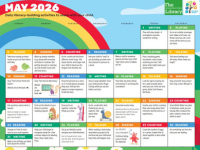
Good readers have a large vocabulary. Knowing lots of words helps children better understand what they read. You can help your children learn lots of words by: Having plenty of conversations. Take turns talking. It is important for you to ask questions and listen to what your children say in response. Read together! A lot! Make connections. Connect what you are reading in books to their lives. “Yes, Grandma has a black cat, too.” Repetition. Children often love to read the same book over and over. This is a good thing as repeated readings help build vocabulary.
- Play with play dough – it strengthens muscles needed for writing.
- Go on an outside scavenger hunt. Make a list (tree, car, flower, bird, bus, etc.) and check off the items as you see them.
- Take turns saying as many words as you can that rhyme with May.
- Make up simple melodies to go along with everyday activities or routines, like getting dressed or cleaning up. Use familiar tunes and add new lyrics.
- Go for a walk and find three different-sized twigs. Talk about shorter and longer. Ask your child to hand you the longest, shortest, etc.
- Ask your child to “read” to you by telling you their own story based on pictures in a book.
- Make a card for someone special and have your child “sign” their name. Scribbles are ok!
- Play a stacking game. Use blocks, rocks, boxes, anything you have. Talk about what might make your stack tumble.
- Talk about feelings you felt today. What made you laugh?
- Sing “The Farmer Plants the Seeds." Sing to the tune “The Farmer in the Dell” The farmer plants the seeds, / The farmer plants the seeds, (Pretend to plant seeds) / Hi, ho, the dairy-o, / The farmer plants the seeds. / The sun comes out to shine (Make large circle with arms) / The rain beings to fall (Hands flutter up and down) / The seeds begin to grow (Stand up tall) / The farmer picks the crops (Pretend to pick crops) / We all sit down to eat(Pretend to eat)
- Sing “The Ants Go Marching. The Ants Go Marching / The ants go marching one by one, hurrah, hurrah. / The ants go marching one by one, hurrah, hurrah. / The ants go marching one by one, The little one stops to eat a plum, / And they all go marching down, To the ground, to get out of the rain. / BOOM BOOM BOOM / Two by two. Tie its shoe / Three by three. Climb a Tree. Four by four. Shut the door. / Five by five. Take a dive. / Six by six. Pick up sticks. / Seven by seven. Tie a ribbon. / Eight by eight. Close the gate. / Nine by nine. Check the time. / Ten by ten. Say THE END.
- Draw the pictures to a story on 4-5 small pieces of paper. Help your child put the papers in proper sequence to tell the story.
- Draw a large alphabet. Have your child practice finger tracing while you say the letters out loud.
- Play hide and seek, taking turns being “it” and doing the countdown.
- Look for signs of spring. Go for a walk and talk about what you see. Point out new gras, birds, first flowers, leaf buds.
- Sing a favorite song. Sing it fast. Sing it slow. Whisper it.
- Ask questions about what is heavier. Does an orange or a grape weigh more? Is Mom’s shoe or your shoe heavier?
- Find out the details of your library’s summer reading program.
- Draw pictures together. Label the things you draw.
- Go for a walk after dark. Pretend you are an explorer. Talk about what you see.
- Enunciate words today. Would you like a ba-ba-ba-nana? Banana begins with B! Can you close the d-d-d-door? Door beings with D!
- Involve your child in creating their own songs about their interests, favorite stories, or experiences.
- Snack Math! Make two piles of whatever snack you are having, then compare the piles – which is more and which is less?
- Point to each word as you read together.
- Help your child begin to recognize words for a few common objects by labeling them. Shoe, Table, Door, Floor.
- Set up an obstacle course and give your child directions. Run to the park bench. Jump over the stick. Touch the ground. Come back to me.
- When reading a book today stop before you get to the end and ask your child what they think will happen next.
- You: ABCDEFG / Child: HIJKLMNOP Continue taking turns to finish the alphabet.
- Count the number of eggs in a carton. Explain that 12 items together is also called a dozen.
- Act something out from the story you are reading.
- Make a list of things you liked best about this month.
June
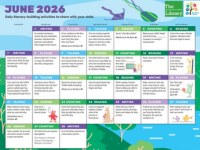
One way children learn vocabulary is from listening to stories. They listen to understand what is being said, which helps them learn new words. Stories aren’t just found in books. You can tell stories about your day, your memories from growing up, or something about your child’s life. You can also use wordless picture books and make up a story together. With wordless books, you can develop imagination along with language and vocabulary skills. Make it fun! Having fun with words helps your child become more aware of words and eager to learn more.
- Go outside and observe insects like ants, butterflies, and bees. Talk about their behaviors and habitats. Draw images of the insects.
- Sit on cushions on the floor and pretend to be in a boat. Sing “Row, Row, Row, Your Boat.” Row, Row, Row Your Boat / Row, Row, Row Your Boat / Gently down the stream / Merrily merrily, merrily, merrily / Life is but a dream.
- Pick out a family snapshot or random picture and ask your child to tell you about it. Expand on what your child says to create a story.
- Recite “Little Miss Muffet.”
Little Miss Muffet / Little Miss Muffet / Sat on a tuffet, / Eating her curds and whey / Along came a spider / And sat down beside her / And frightened Miss Muffet away.
- Measure your child’s height and write it here: _____. Compare it to January’s measurement.
- Look at the covers of books together. Talk about what the book might be about.
- Draw the outline of your child’s hand. Write the date and have your child “sign” the drawing.
- Mystery Bag! Put 4-5 items in a bag. The child feels, describes, and guesses.
- Talk about summer. What are your favorite things to do in the summer? How are summer and winter different?
- Turn short stories or daily events into a song. Make up lyrics that narrate the story, using a melody that’s easy for children to follow.
- Weigh your child and write it here: _____. How does it compare to January?
- Read a book about flowers and plants.
- In the morning write today’s To-Do list. Check things off as you do them.
- Play Leap Frog with stuffed animals. Explain that the game is called Leap Frog because players resemble frogs leaping through the air.
- Talk about colors. What is your favorite color and why? Find your favorite color as many times as you can today.
- Recite the nursery rhyme “Diddle Diddle Dumpling” Diddle Diddle Dumpling / Diddle diddle dumpling, my son John / Went to bed with his trousers on / One shoe off, and one shoe on / Diddle diddle dumpling, my son John.
- Have the whole family take turns counting all their fingers and toes.
- While reading a familiar book today, pause here and there to allow your child to say some of the words.
- Make a word jar. Each day write a new word on a slip of paper and add it to the jar. Take turns pulling words out and discussing.
- Play “Red Light, Green Light” Red Light, Green Light One person is the traffic light. When they say green light everyone can move towards the finish line. When they say red light everyone must immediately stop. Continues until everyone reaches the finish line.
- Make a nature crown using leaves, flowers, and sticks. What did you use and why? Nature Crowns. Cut a strip of paper or cardboard to fit your head. Collect leaves, flowers, or small sticks. Tape or glue them on. Wear your crown and chare your creation!
- Sing one of your children’s favorite books.
- Count how many kisses you give your child today. Keep a tally and add them up at the end of the day.
- Look at a magazine together. Explain some of the pictures or illustrations.
- Work with your child to practice tracing. Draw big letters and shapes for them to trace.
- Pretend you are swimming in the ocean. What do you see? Describe the fish, the plants, the sand, the seashells, etc.
- After reading a book, as your child to “tell it back” in their own words.
- Have a parade. Put on music and march around. Pretend to play instruments.
- Sort items from your grocery bag together. These things go in the pantry. These go in the refrigerator. What goes in the freezer?
- Go to the library and pick out a book about summer.
July
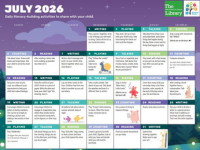
You are your child’s first teacher, and your home is where your child begins to learn. Make your home a great place to learn. It doesn’t take money to create special places where you and your child can talk, sing, read, write, play, and count. Here are a few ideas.
Places to Read
Create a special space for your children to look at books. Have a comfortable chair or pillows and a small shelf or basket for favorite books. Make sure there’s room for you and your child to sit together and that your child can reach books without needing help.
Places to Write
Make it easy for your child to write throughout the day. Set up a space where your child can go on his or her own and use writing materials. Provide pencils, crayons, or markers of different sizes so your child can write with what is most comfortable. Use unlined paper.
Places to Play
Play requires a little space, simple props, and some imagination and encouragement. You don’t need special toys or expensive electronics. Provide props like large boxes, old clothes or costumes for dress up, empty food containers, and empty paper towel rolls. Play comes naturally to young children and is one of the primary ways they learn. Provide plenty of opportunities for your child to play.
- Plan a picnic. Together, write a list of things you will need to bring. Check off the list as you locate the items.
- Play store. Set up a store with your child’s toys. Take turns being the check-out clerk and the shopper.
- Talk about time. Draw a sun and underneath, write down thingsthat happen during the day. Draw a moon and list thingsthat happen at night.
- Sing a song with movement,
like “BINGO.” There was a farmer who had a dog and Bingo was his name-oh. / B-I-N-G-O / B-I-N-G-O / B-I-N-G-O / and Bingo was his name-oh. / There was a farmer who had a dog and Bingo was his name-oh. / (clap)-I-N-G-O / (clap)-I-N-G-O / (clap)-I-N-G-O / and Bingo was his name-oh. / CONTINUE UNTIL ALL THE LETTERS IN BINGO’S NAME ARE REPLACED WITH CLAPS. - Talk about sizes. Draw small boxes and large boxes. Ask your child to circle the small boxes.
- After reading a book, take turns making up possible new titles for it.
- Write a short message and tuck it in your child’s shoe. Read it together when your child finds it.
- Play “Follow the Leader” outside. Take turns being the leader.
- Use a fruit or vegetable your child loves. Talk about how it looks, tastes, smells, feels. Where does it grow? Where do you purchase it?
- Play music with a fast tempo as you pick up and put away toys. Who can pick up the most toys?
- Compare amounts. You have more crackers than I do. I have more blueberries than you do.
- Vary your voice as you expressions to help your child learn about feelings.
- Draw the outline of your child’s hand on a piece of paper. Write the date and have your child “sign” the drawing. Save it.
- Lay out letter cards on the floor. Children hop from one letter to another as you call out letters.
- Take a walk outside. Talk about all you see. Talk about the weather and how it is different than in winter.
- Sing or recite
“Mary Had a Little Lamb.” Mary had a little lamb, / Its fleece was white as snow, / And everywhere that Mary went / The lamb was sure to go; / It followed her to school one day / Which was against the rules, / It made the children laugh and play / To see a lamb in school. - Count how many birds you see today. Keep a list. Note location, color, sounds. At the end of the day look at your list and discuss.
- After reading a book together have a conversation. Talk about your favorite parts.
- Encourage children to write letters to family members. This can be as simple as drawing a picture and adding a few words or their name.
- Encourage children to engage in imaginative play where they create stories and scenarios using dolls, action figures, or other toys.
- At bedtime talk about where various animals sleep at night.
- Play “Freeze” while dancing to music. When the music stops, everyone has to freeze.
- Use a piece of string to measure things.
- Read a book about summer.
- Ask your child to dictate a letter to a special person. Show how to address an envelope and add a stamp. Then mail the letter together.
- Play “Riddle Me.” I’m bigger than your hand and I’m in the kitchen. What am I? Yes, A banana!
- Talk about things you do in the morning, things you do in the afternoon, and things you do at night.
- Play “Echo Me.” Clap, stomp, or beat a drum and have your child repeat the noise.
- Create a grocery list with your child. Together, look at what you have and decide what you will need to purchase.
- Point out words everywhere you go today.
- Spend time drawing together. Make sure to sign your art!
August
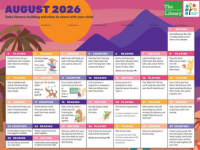
Children’s reading success in kindergarten and beyond begins with positive language and literacy experiences from the time they are infants.
Young children have shorter attention spans. You can do activities for short bits of time throughout the day or whenever you have the chance.
You can help your children learn in ways and at times that are best for them.
Children learn best by doing—and they love doing things with YOU!
- Use building toys like LEGO or wooden blocks to form letters of the alphabet.
- Pretend Library. Set up a small library and a checkout table. Take turns checking out books.
- Talk about bigger and smaller. What is bigger, A house oracat?
- Make music with things you have in the house like pots, pans, spoons, boxes, and cups.
- Talk about time. How long does it take to get to the park? How long does it take to get to the library?
- Read a nonfiction book about birds. Talk about what you’ve learned. Say the rhyme “If I Were a Bird.” If I were a bird, I’d sing a song / And fly about the whole day long. / And when the night comes, go to rest, / Up in my cozy little nest.
- Label the things in your child’s room. Bed, dresser, table, book, closet. Point to the words and discuss.
- Play with blocks. What can you make? Form the blocks into a letter shape.
- Take an alphabet walk outside. Talk about things letter sounds.
- Sing or say “The Itsy Bitsy Spider.” The itsy bitsy spider went up the water spout. (Move fingers up toward sky) / Down came the rain and washed the spider out. (Bring fingers down and back) / Out came the sun and dried up all the rain (Move arms up over head) / And the itsy bitsy spider climbed up the spout again. (Move fingers up toward sky) REPEAT WITH “GREAT BIG SPIDER” USING A GRUFF, DEEP VOICE.
- Go on a nature walk and count items you find, such as leaves, rocks, or flowers.
- Look at pictures in magazines or newspapers. Take turns telling stories about the pictures.
- Draw a picture for a grandparent or other important person. Be sure to “sign” it.
- Play “What Fits?” Will the car fit inside your shoe? Will your shoe fit inside the car?
- Plan a visit to your local library. Talk with your child about everything the library offers (books, toys, games, programs, etc.).
- Pick a new kind of music you haven’t listened to before. Listen together. Discuss.
- Set the table for a meal. How many plates will you need? How many utensils? Napkins?
- Hide a small toy. Draw a simple map with X marking the spot and follow the map together.
- Use play dough to shape your child’s first name.
- Play the yes-no game about time. Is it time for breakfast? Is it time to read? Is it time for kisses?
- Before going to bed, talk about things you did this morning, this afternoon, and tonight. What will you do tomorrow?
- Sing a “good morning” song to greet your child in the morning.
- Put the family’s shoes in order from biggest to smallest.
- Choose a picture book and read it together.
- Write your child’s first name. Talk about the first letter of their name. Make the sound and say words that begin with the letter.
- Sing “Scarecrow, Scarecrow” and do all the movements. Sing to the tune of “Twinkle,
Twinkle, Little Star” Scarecrow, scarecrow, turn around, / Scarecrow, scarecrow, touch the ground. / Stand up tall and blink your eyes. / Raise your hands up to the sky. / Scarecrow, scarecrow, touch your toes. / Scarecrow, scarecrow, tap your nose. / Swing your arms so very slow, / Now real fast to scare the crows. / Raise your head, jump up and down. / Now sit down without a sound. - Offer choices today. Do you want this book or that one? Do you want water or milk? Would you like a banana or strawberries?
- Take turns singing bits of favorite songs.
- Create a picture graph with two meal options. Have each family member vote for their preferred choice, and then tally the votes together with your child.
- Go to the library and check out a new book.
- Create letters with playdough to improve fine motor skills.
September
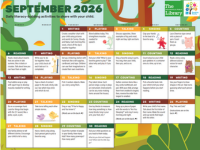
Play and have fun with words.
Read a book with lots of made-up words like “How Do You Wokka-Wokka?“ by Elizabeth Bluemle. Try making up more words to go with the story.
Silly poems are fun and can teach new vocabulary.
Kids love riddles and jokes, which often use a “play on words.” Laugh along as you talk about the answer to the riddle or joke.
Having fun with words helps your child become more conscious of words and happy to keep learning.
- Create a weather chart with your child using pictures and words for Sunny, Cloudy, and Rainy. Each morning this weather together.
- Blow bubbles today. This strengthens muscles needed for speech.
- Discuss opposites. Show examples of big and small, night and day, light and dark.
- Clap your hands to the beat of a favorite song.
- Lace Cheerios-type cereal onto a piece of yarn. Count them as you go.
- Read a book about insects that are active in late summer, like crickets or cicadas. Talk about how you can hear them at night.
- Write your to-do list together. Have each task as it is completed.
- Set up a tinkering station with materials like craft supplies, cardboard, and tape. Children can use their imaginations to create their own inventions.
- Ask your child “What is your favorite game to play?” Talk about why and play it if you can.
- Sing a favorite song in parts. You sing, then your child, then you, and so on.
- Count aloud as your child puts pebbles in a container one at a time, up to ten.
- Read a story using voices for each character.
- Pop bubble wrap or play with squirt toys to develop muscles needed for writing.
- Tape a sheet of contact paper to the wall, sticky side out. See which toys stick and which do not.
- Pick 3 random objects. Make up a story using them.
- Play talent show. Each person sings a song or plays an instrument. (Instruments can be any noise-making items around the house.)
- Gathercommon itemslike a key, comb, toothbrush, and pen.With yourchild, arrange them from smallest to largest; then, reverse the order from largest to smallest.
- Pick a favorite book. Ask your child to tell you what happens before you start reading.
- Use your fingers to draw shapes in the air. Take turns guessing what each person drew.
- Go on a scavenger hunt. Look for things that begin with the “p” sound, like a plate, a pan, a pen.
- Take turns telling each other simple stories.
- Sing or say “If You’re Happy and You know It.” If you’re happy and you know it clap your hands. (clap, clap) / If you’re happy and you know it clap your hands. (clap, clap) / If you’re happy and you know it and you really want to show it, if you’re happy and you know it clap your hands. (clap, clap) OTHER VERSES: STOMP YOUR FEET! TURN AROUND! SHOUT HOORAY! DO ALL FOUR!
- Use toy blocks to measure how long something is. How many blocks long is your arm, your foot, etc.?
- Hang up a piece of paper with the words to “Are You Sleeping?” and sing it every morning and night. Are you sleeping, are you sleeping? / Brother John, Brother John? / Morning bells are ringing, morning bells are ringing, / Ding ding dong, ding ding dong.
- Write your child’s first name. Talk about the first letter of their name. Make the sound and say words that begin with the letter.
- Play “Hot and Cold.” 1. Select a household item for hiding. 2. The finder closes their eyes while the hider hides the item somewhere in the room. 3. The finder searches for the item while the hider provide clues. 4. When the finder is close to the item, the hider responds “you’re hot!” 5. When The finder is far from the item, the hider responds “you’re cold!” 6. Take turns being the hider and the finder.
- Use family photos to tell your child to tell a story.
- Have a family sing-along. Each person gets to pick a favorite song.
- Count the number of people in your family. How many kids? How many grownups? How many pets?
- Ask your child questions as you read to them today. What do you think will happen next? Where did the little dog go?
October
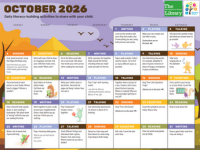
Parents are tremendous role models. If your children see that you think reading is important and enjoy it, they will follow your lead. When you go to the library, check-out books for you and your children. Put your books somewhere at home where your child can see them. Let your children see you reading. Talk about what you’ve read, even if it is just to say, “That was a good book. I liked reading it.”
- Look out the window with your child and create a list of everything you see, using both pictures and words.
- Make your own masks and use them in play. PAPER PLATE MASKS Cut eye holes in a paper plate. Color or paint your mask. Add yarn, feathers, or paper shapes. Attach string or a stick to hold.
- Talk about the weather today and what you should wear to go outside.
- Sing “good morning” using the Happy Birthday song. Good morning to you, good morning to you. good morning (child’s name), good morning to you.
- Work with your child to draw an imaginary monster. Ask your child how many arms, eyes, teeth? What color?
- Go to the library and take out a new book. Talk about new words you come across while reading the new book.
- Write a grocery list together. Walk around the kitchen checking what you might need and add it to the list.
- Take a walk outside. Collect colorful leaves. Try to find as many different types as possible.
- Use interesting new words. For example, delightful in place of good; voracious in place of hungry, scrumptious in place of delicious.
- Take turns singing bits of the alphabet song.
- Trace the hand of each person in your family. Whose hand is bigger? Whose is smaller?
- Spot letters on license plates today. Call them out as you see them.
- Write your child’s name in big letters. Decorate the page and hang it where they can see it.
- Play “I Spy” with rhyming words. I spy with my little eye something that rhymes with pie. What is it?Yes, Sky!
- Together draw a picture of a bus. Create a short story about the bus’s journey. Where is it going? Why are the passengers getting on and off?
- Sing “Five Little Speckled Frogs.” Five little speckled frogs (hold up five fingers) / Sat on a speckled log / Eating the most delicious bugs / YUM! / One jumped into the pool (put down one finger) / Where it was nice and cool / Then there were four speckled frogs (hold up four fingers) START OVER FROM THE BEGINNING BUT WITH FOUR SPECKLED FROGS, THREE SPECKLED FROGS, TWO SPECKLED FROGS, ONE SPECKLED FROG. “THEN THERE WERE NO SPECKLED FROGS!”
- Pick a point in your house or on your block. Count the steps to get there.
- Hold a favorite book upsidedown or start reading it backwards. Talk about what is “wrong” with the way you are reading the book.
- Work together to plan a walk around your neighborhood. Draw a map before you go and use it while you are walking.
- Play “restaurant.” Create a menu together.
- Use interesting expressions. I’m all ears in place of I’m listening.
- Sing “Five Little Ducks.”
Five little ducks Went out one day Over the hill and far away / Mother duck said “Quack, quack, quack, quack” But only four little ducks came back. / Four little ducks Went out one day Over the hill and far away / Mother duck said “Quack, quack, quack, quack.” But only three little ducks came back. / Three little ducks Went out one day Over the hill and far away
Mother duck said “Quack, quack, quack, quack.” But only two little ducks came back. / Two little ducks Went out one day Over the hill and far away / Mother duck said “Quack, quack, quack, quack.” But only one little duck came back. / One little duck Went out one day Over the hill and far away / Mother duck said “Quack, quack, quack, quack.” But none of the five little ducks came back. / Sad mother duck Went out one day Over the hill and far away / The sad mother duck said “Quack, quack, quack, quack.” And all of the five little ducks came back. - Count the pumpkins you see today. Keep a tally.
- Read a book about fall.
- Write a list of words that rhyme with dog.
- Play a rhyming riddle game. What do you see that rhymes with bee? Yes, a tree!
- Smell different things and talk about them: spices, flowers, fruit, and cocoa. Which scents do you like or dislike?
- Dance to a fast song and then dance to a slow song. Clap along to both songs.
- Roll a die. Count the dots each time.
- Point out words everywhere you go today.
- Draw a giant letter and drive a toy car along it.
November
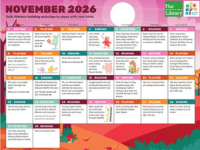
Listening to nursery rhymes and songs is an early literacy experience that helps children understand how language and stories work. Recite rhymes and sing songs with children from the time they are infants. This helps them become aware of and then play with the sounds in the words. Many rhymes tell a story with a beginning, middle, and end. This shows children how stories work and that events happen in a sequence. Good readers understand that stories and books have a beginning, middle, and end. After reciting a rhyme or singing a song ask your child about the song. What happened at the beginning? What happened at the end?
- Create a list of things to do this month. Hang it up where everyone can see. Have your are completed.
- Make a story box and tell stories together. 1. Use a small box and decorate it together. Label it Story Box. 2. Find random pictures with no words to add to the story box. Use family snapshots, advertisements from magazines, and other pictures. 3. At story time each person takes a picture (without peeking) and tells a short story about the picture.
- Would you Rather? Ask each other silly questions with silly choices.
- Have a family sing-along. Each person gets to pick a favorite song.
- Draw a large pizza decorated with toppings. Divide it into slices using a marker or scissors. Ask your child, “Can you count the slices? Each one is part of our pizza.”
- Read a book that won the Caldecott Medal. The library will help you find one based on what your child likes.
- Draw a map of your neighborhood. Include landmarks your child knows. The park, the library, the red house on the corner.
- Go on a walk and collect leaves. Ask questions. What color is that leaf? Are those two leaves the same or different?
- Talk about your favorite books. Which do you like best and why?
- Recite “Rub a Dub Dub” Rub a Dub Dub / Three Men in a Tub / And Who Do You Think They Be? / The Butcher, The Baker, The Candlestick Maker / And All of the them Out to Sea
- Roll a small ball back and forth. Count to ten with each person saying a number each time they roll the ball.
- Read fiction and nonfiction books about fall. Your library has lots to choose from!
- Provide a variety of stickers and a blank sheet of paper. Ask your child to create a scene or tell a story with stickers.
- Make a blanket tent. Pretend you are sleeping there overnight. What will you bring? Read a book together in the cozy tent.
- Wish upon a star tonight. Recite “Star Light, Star Bright.” Star light, star bright, / The first star I see tonight; / I wish I may, I wish I might, / Have the wish I wish tonight.
- Sing a favorite rhyming song. Stop at the end of a line and
have your child fill in the word. Twinkle, twinkle, little star
How I wonder what you are Up above the world so high Like a diamond in the sky Twinkle, twinkle little star How I wonder what you are - Fill a jar with small objects and have your children estimate how many are in the jar. Then count together to see who was closest.
- Snuggle together and read two favorite books and one new book you haven’t read yet.
- Show the steps for doing something simple, like brushing your teeth or putting on your shoes. You can write the steps or draw pictures.
- Take turns naming animals and making animal sounds.
- Talk about opposites. Reach high to the sky and low to the ground. Take a big step and a little step.
- Play favorite songs. Bounce, tap, clap to the rhythm.
- See how many cotton balls you can fit into a variety of different-sized containers. How many fit in this cup? How many can fit in your pocket?
- Use your finger to follow along with the words in the book as you read to your child today.
- Make a book with your child. Draw letters and pictures to tell a story. Tape the pages together.
- Go for a morning walk. Walk slow. Walk fast (toddler pace). Repeat.
- Rhyming Day! Incorporate rhymes wherever you can. Look at the birds, they fly high in the sky.
- March to a drum. Use any empty container to act as a drum.
- Use rulers, measuring tape, or even footsteps to around the house or outside.
- Read a book about winter.
December
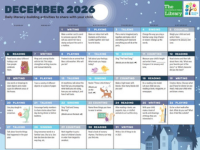
Your library helps children get ready to read.
The library has many materials and ideas you can use to talk, sing, read, write, play, and count with your child. It doesn’t matter if your child is four days old or four years old, we have books, music, programs, and services to help your child develop language and prereading skills.
We have books to read together, music to borrow, places where you can write, places to play and learn, and programs for all ages.
- Make a winter card to send to someone special. Who will you send it to? Use a stamp and post the card in a mailbox.
- Make an indoor tent with blankets and furniture. Cuddle together and read favorite books.
- Plan a real or imagined party together and make a list of everything you’ll need and everything you will do at the party.
- Change the way you sing a familiar song. Sing it faster or slower. Change up the words.
- Weigh your child and and write it here: ________ Compare it to January and June.
- Read books about different holidays and how people celebrate them.
- Wrap and unwrap blocks with tin foil. This helps strengthen writing muscles and manual dexterity.
- Pretend to be an animal that likes cold weather. Who will you be?
- Talk about your feelings. What made you happy today?
- Sing “The Frost Song.” Sing to the tune of “The Farmer in the Dell” The frost is in the air. / The frost is in the air. / It's wintertime, it's wintertime, / The frost is in the air. / The frost tells me it’s cold. / The frost tells me it’s cold. / It’s wintertime, it’s wintertime, / The frost tells me it’s cold. SING OTHER VERSES IN WHICH THE FROST IS “ON THE ROOF,” “ON THE WINDOWS,” AND “ON THE GROUND”
- Measure your child’s height and write it here: ________ Compare it to January and June.
- Read stories and then talk about them. Ask, ‘What was your favorite part of the story?’ or ‘Which character did you like best?’
- Use words or drawings to label objects and create signs for different areas of the house.
- Trace a variety of different objects on a piece of paper.
- At mealtimes, talk about the food that you are preparing, what tools you are using, how you are making it, and how it will taste.
- Recite “Three Little Kittens.” The three little kittens, they lost their mittens, / And they began to cry, / “Oh, mother dear, we sadly fear, / That we have lost our mittens.” / “You lost your mittens? / You poor little kittens. / Well, let us have some pie. / Meow, Meow, Meow / Let us have some pie.”
- Make a high tower with blocks. How many blocks did you use?
- Be a reading role model. Let your child see you reading a book, magazine, or newspaper.
- Create a Menu: Discuss what you’ll have for dinner (or any meal). Help your child write and draw a menu.
- Use play dough to make a snowman.
- Encourage family members to share stories about their day during dinner or before bedtime.
- Sing “Cold and Snowy Morning” This is the way we put on our mittens / Put on our mittens / Put on our mittens / This is the way we put on our mittens / On a cold and snowy morning / This the way we put on our coats / Put on our coats / Put on our coats / This is the way we put on our coats / On a cold and snowy morning / This is way we put on our hats / Put on our hats / Put on our hats / This is the way we put on our hats / On a cold and snowy morning / This is the way we shovel the snow / Shovel the snow / Shovel the snow / This the way we shovel the snow / On a cold and snowy morning / This is the way we build a snowman / Build a snowman / Build a snowman / This is the way we build a snowman / On a cold and snowy morning.
- Name three things you have to wear in winter.
- After reading a book, use puppets, toys, or stuffed animals to act out the story.
- With your child, make a book of words and drawings of things they are interested in.
- Go for a short walk after dark. What do you see? What does it feel like outside?
- Talk about favorite things that happened in the past year.
- Sing nonsense words to a familiar tune. Sha la la. Doo bee doo bee doo bee doo wop bop, etc.
- Work together to put a stack of children’s books in order from largest to smallest.
- Read a book of nursery rhymes. The library can help you find one.
- Write a list of things to do in 2027.